Viral Launch vs Sydon.ai: The Complete Migration Guide (2026)
Viral Launch stopped accepting new customers in January 2026. If you're looking for an alternative, this guide compares Sydon AI, Helium 10, and Jungle Scout across product research, keyword tracking, PPC automation, and listing optimization, helping you understand what each platform replaces, where the gaps remain, and which option fits your workflow.
Viral Launch stopped accepting new customers on January 5, 2026. This guide maps each Viral Launch workflow to what Sydon AI offers today, where Helium 10 or Jungle Scout may fit better, and where there’s still a gap. Viral Launch stopped accepting new customers on January 5, 2026. Worldeye Technologies had acquired the company in 2023, and the viral-launch.com domain now redirects to Intellifox, another product from the same parent company. If you’re evaluating what comes next, you deserve a straight answer, not a sales page. This guide maps each Viral Launch workflow to what exists today, explaining where Sydon AI provides an alternative, where Helium 10 or Jungle Scout may be a better fit, and where genuine gaps remain.
What Viral Launch actually did
Before comparing alternatives, it helps to understand what Viral Launch was designed to do. It was primarily a product research and market intelligence tool rather than a comprehensive operations platform. Its core capabilities focused on helping Amazon sellers discover products, analyze competitors, research keywords, optimize listings, and manage advertising.
Product Discovery helped sellers identify and evaluate opportunities through filter-based product research, while the Market Intelligence Chrome extension displayed sales estimates and competitor data directly on Amazon product pages. Keyword Research provided search volume and competition insights, and Competitor Intelligence offered reverse ASIN lookups to identify the keywords competitors were ranking for.
Viral Launch also offered Listing Builder and LaunchGPT for AI-assisted listing creation with a keyword bank, Kinetic PPC (AdSprout) for rule-based advertising automation on higher-tier plans, and Keyword Manager for tracking keyword rankings over time.
What Viral Launch didn’t do was take on the broader operational responsibilities involved in running an Amazon account. Monitoring account health, handling compliance cases, planning inventory, and recommending prices were outside its primary scope. Understanding that distinction matters when deciding which alternative can replace the workflows you previously relied on.
Feature by feature: VL vs what exists now
Product Discovery
Viral Launch’s Product Discovery was one of its flagship features, helping sellers research potential products and identify sourcing opportunities through a large database of product and market information.
What exists now: Sydon AI’s Product Scout approaches product discovery by answering a more specific question: is this product, keyword, or niche worth investing in? It combines product discovery, keyword and sub-niche market research, a profit calculator, and product monitoring to help sellers evaluate opportunities.
Rather than focusing only on an individual listing, Product Scout evaluates the broader market a product would enter. It scores opportunities across six dimensions: demand, review wall, competition, economics, room to differentiate, and momentum. Based on that analysis, it provides a GO, CAUTION, or NO-GO verdict. Certain conditions can override the overall score, including Amazon holding the Buy Box, one brand dominating page one, or a substantial wall of reviews. Every number is identified as measured, modeled, or a proxy, while unknown values are displayed as a dash rather than being treated as zero.
There are also limitations to consider. Product Scout doesn’t check intellectual property, trademarks, or patents, confirm whether a seller is eligible to sell a particular product, or account for seasonality. Honest call: If your priority is browsing and filtering a very large product database, Helium 10 and Jungle Scout are designed around that workflow. If you want a clear verdict on whether a specific market is worth entering, with the reasoning behind the decision made visible, Product Scout is built for that. There are also limitations to consider. Product Scout doesn’t check intellectual property, trademarks, or patents, confirm whether a seller is eligible to sell a particular product, or account for seasonality. Honest call: If your priority is browsing and filtering a very large product database, Helium 10 and Jungle Scout are designed around that workflow. If you want a clear verdict on whether a specific market is worth entering, with the reasoning behind the decision made visible, Product Scout is built for that.
Market Intelligence Chrome Extension
One of Viral Launch’s most popular capabilities was its Market Intelligence Chrome extension. It allowed sellers to view sales estimates, price history, and competitive information directly on Amazon product pages without switching between multiple research tools.
What exists now: Sydon AI doesn’t currently offer a publicly available browser extension that replaces this particular workflow. Helium 10’s Xray and Jungle Scout’s extension both provide on-page market research capabilities that more closely resemble what Viral Launch offered. Honest call: If having market data available directly on Amazon product pages is central to your research process, Helium 10 or Jungle Scout is a better fit for this specific requirement today.
Keyword Research
Viral Launch’s Keyword Research tool helped sellers discover relevant search terms, evaluate keyword opportunities using search volume and competition data, and bring selected keywords into its Listing Builder.
What exists now: Sydon AI’s Keyword Scout supports this workflow by allowing sellers to enter a product phrase and expand it into related terms shoppers use when searching. Sellers can organize relevant keywords into free, unlimited keyword lists and use the free Sydon Recommended shortlist, which scores up to 20 keywords.
Selected keywords can also be sent directly to Listing Builder, where they remain available for review before being accepted into the listing copy. This creates a connection between keyword research and listing optimization without automatically applying every keyword recommendation. It's important to understand the limitations of the underlying data. Search volume figures are vendor estimates rather than official Amazon search volume data, and Keyword Scout makes that distinction clear. Coverage is currently focused on the US marketplace, with a daily search allowance. Helium 10’s Magnet and Cerebro, along with Jungle Scout’s keyword research tools, also provide strong alternatives for sellers who depend heavily on keyword discovery and analysis.
Competitor Intelligence (reverse ASIN)
Viral Launch’s Competitor Intelligence allowed sellers to enter a competitor’s ASIN and identify the keywords that product was ranking for. This helped sellers understand competitor visibility and discover keywords they might have overlooked.
What exists now: Sydon AI’s Keyword Scout supports both phrase-based and competitor ASIN searches. Sellers can enter a competitor’s ASIN to see the keywords associated with that product’s rankings, making it useful for reverse ASIN research.
However, Keyword Scout doesn’t currently estimate competitor revenue or alert sellers when competitors make changes to their listings. Helium 10’s Cerebro is another strong option for reverse ASIN keyword research.
Honest call: If your primary goal is identifying the keywords competitors rank for, Keyword Scout covers that workflow. If you also rely on competitor revenue estimates or listing-change alerts, Helium 10 or Jungle Scout may be better suited to those requirements.
Listing Builder and LaunchGPT
Viral Launch’s Listing Builder helped sellers create product titles, bullet points, and descriptions using AI-generated content and a live keyword bank. LaunchGPT extended that functionality to support listing creation for larger product catalogs.
What exists now: Sydon AI’s Listing Builder focuses on reviewing and improving existing product listings while reducing the risk of inaccurate or noncompliant content. It evaluates listings against 124 US listing rules and 11 category-specific rule packs, identifying issues along with supporting evidence and severity levels.
The tool can draft improved titles, bullet points, product descriptions, backend keywords, and attributes using information from the seller’s own product record. It applies Amazon’s 75-character title policy and the 249-byte backend keyword limit, while refusing or repairing drafts that introduce unsupported specifications or prohibited claims. Every suggested change requires seller approval, and nothing is published without that approval.
Helium 10’s Listing Builder also supports listing creation and optimization, making it another option worth comparing. Honest call: Sydon AI’s Listing Builder is designed primarily to improve existing listings safely rather than generate large numbers of new listings in bulk. If bulk listing creation was your main reason for using LaunchGPT, compare the available tools carefully before migrating.
Kinetic PPC (AdSprout)
Viral Launch’s Kinetic PPC, also known as AdSprout, provided rule-based advertising automation for sellers on its higher-tier plan. It helped advertisers manage PPC campaigns using predefined rules and automated bid adjustments.
What exists now: Sydon AI’s PPC Optimizer approaches advertising differently from a traditional rule-based bidding engine. It analyzes Sponsored Products performance and evaluates keywords and campaigns against the product’s actual break-even point rather than relying on ACOS alone
The agent identifies potentially wasted spending using settled data, accounting for late-attributed orders before deciding that spend is inefficient. It recommends negative keywords while checking whether exclusions could block search terms that are already performing well. It also identifies profitable demand that may be constrained and investigates whether poor advertising results are connected to listing quality, pricing, or inventory availability rather than the bid itself.
This broader context matters when making spending decisions. For example, PPC Optimizer avoids recommending increased advertising spend for a product approaching a stockout, even if its current advertising performance appears strong. Each proposed change requires seller approval, and proposals expire after 72 hours.
Helium 10’s Adtomic is a more direct alternative for sellers looking to replace Kinetic’s rule-based advertising automation. Honest call: If you want an automation engine that independently adjusts bids, PPC Optimizer isn’t designed to operate that way today. If your priority is understanding where advertising spend is being wasted, why the problem exists, and what changes are worth making before anything is applied, PPC Optimizer is built for that approach.
Keyword Manager and rank tracking
Viral Launch’s Keyword Manager helped sellers monitor keyword rankings over time, making it easier to identify changes in search visibility and track the performance of important keywords. What exists now: Sydon AI’s Keyword Scout includes a Rank Tracker that records ranking positions for tracked keywords and highlights meaningful changes. It alerts sellers when a keyword drops off page one or falls by 10 or more positions, while displaying 7-day and 30-day changes alongside ranking history.
Rank Tracker supports up to 10 products and 200 keywords per group, with a maximum of 200 tracked keywords per account. After the initial scan, ranking positions are updated when the seller runs another scan. Honest call: If you track a large number of keywords and rely on automatic daily ranking updates, Helium 10 and Jungle Scout currently provide a better fit for that specific workflow.
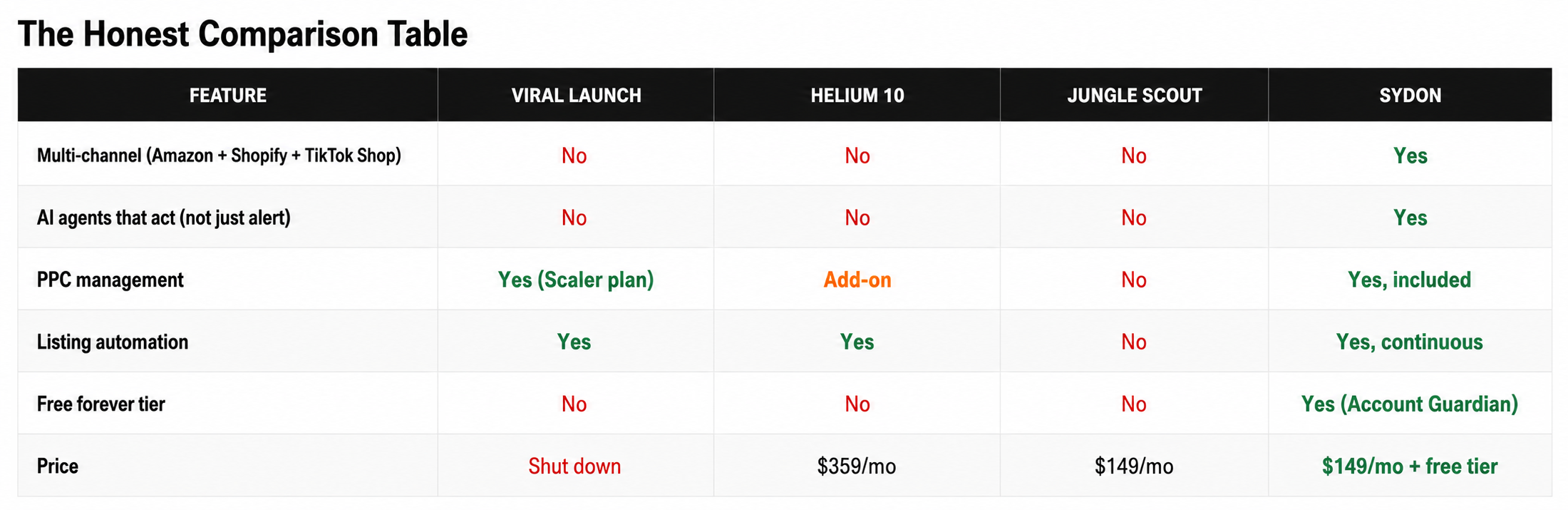
The gap Viral Launch never filled
Viral Launch was built primarily to help sellers research what to sell, identify opportunities, optimize listings, and manage advertising. It wasn’t designed to take responsibility for the operational work that follows, such as monitoring account health, handling compliance cases, planning inventory, recommending prices, or keeping daily fulfillment operations on track.
That’s where Sydon AI takes a different approach. As an agentic platform for commerce operations, it has 13 agents in production today. In addition to its research, listing, and advertising capabilities, the platform includes specialized agents for the operational responsibilities that sellers manage every day.
Account Guardian monitors an account daily against Amazon’s published thresholds and performs a nightly check for suppressed or blocked listings. It is available for free. Compliance Manager helps sellers respond to account violations by opening cases, reviewing Amazon’s notices, and preparing draft Plans of Action that sellers can submit through Seller Central.
Inventory Oracle evaluates stock availability, estimates days of cover and stockout risk, and recommends when and how much inventory to reorder. Dynamic Pricer recommends prices intended to maximize net profit while respecting the seller’s margin floor. Operations Manager identifies orders that may negatively affect the account’s Late Shipment Rate if they aren’t addressed promptly.
These agents are designed to share business context rather than function as isolated tools. An inventory problem can affect advertising decisions, pricing changes can influence profitability, and account-health issues can affect whether a product remains available for purchase. By connecting these areas, Sydon AI aims to reduce the manual coordination sellers typically perform between different tools.
Every change to the seller’s account requires approval, ensuring that people remain in control of the decisions affecting their business. Sydon AI currently starts with Amazon US, but the operational challenges it addresses exist across other commerce channels as well. The platform is designed to extend into those channels over time.
What to do if you were on Viral Launch
The right replacement depends on which Viral Launch workflows were most important to your business. Rather than looking for a single platform that claims to replace everything, start by identifying the capabilities you actually used and the outcomes you need from them.
If product sourcing was your main use, start by evaluating Product Scout for its market-level analysis and GO, CAUTION, or NO-GO recommendations. If your research process depends on browsing a large product database or viewing market information through a browser overlay, Helium 10 or Jungle Scout may be useful alongside it.
If you relied on Kinetic PPC or AdSprout, PPC Optimizer can help identify where advertising spend is being wasted and explain the factors behind those findings. However, if you specifically need hands-off, rule-based bid automation, Helium 10’s Adtomic is worth comparing.
If keyword research and rank tracking were central to your workflow, Keyword Scout covers phrase-based research, reverse ASIN analysis, and ranking updates with alerts for significant drops. Sellers managing very large keyword sets or requiring automatic daily rank updates may find Helium 10 or Jungle Scout better suited to their needs.
If you want to get started without a commitment, Sydon AI’s Account Guardian is available for free. It provides a way to begin monitoring account-health risks without first migrating your entire research or advertising workflow.