The runtime harness: the software around every agent while it runs
The runtime harness is the software around Sydon AI's seller-facing agents while they run. It limits what each agent can do, puts account changes in an approval card by default, and checks every action again before it reaches your account.
The problem it solves
In December 2014, a repricing glitch on Amazon UK pushed prices down to a penny. One seller took around 1,600 orders in an hour before anyone could stop it. Amazon later cancelled most of the orders, but not before some had already shipped.
That story still comes up whenever sellers talk about automation. The fear was never that software would be slow. The fear is that software will be fast and wrong while you are asleep.
A smarter model does not fix that on its own. What fixes it is the software wrapped around the agent while it runs.
What the runtime harness is
The runtime harness is the software around our seller-facing agents while they run. It does three things:
- It limits what each agent can do.
- By default, it puts every account change in an approval card for you.
- It checks every action before it reaches your account.
The agents do the work. The harness decides the shape of the work they are allowed to do, and makes sure nothing reaches your account without passing through it.
Limits on what each agent can do
Each agent runs inside limits set for its job. Some are about what it may do at all. Others are about how far and how fast a change can go.
Real limits from live agents:
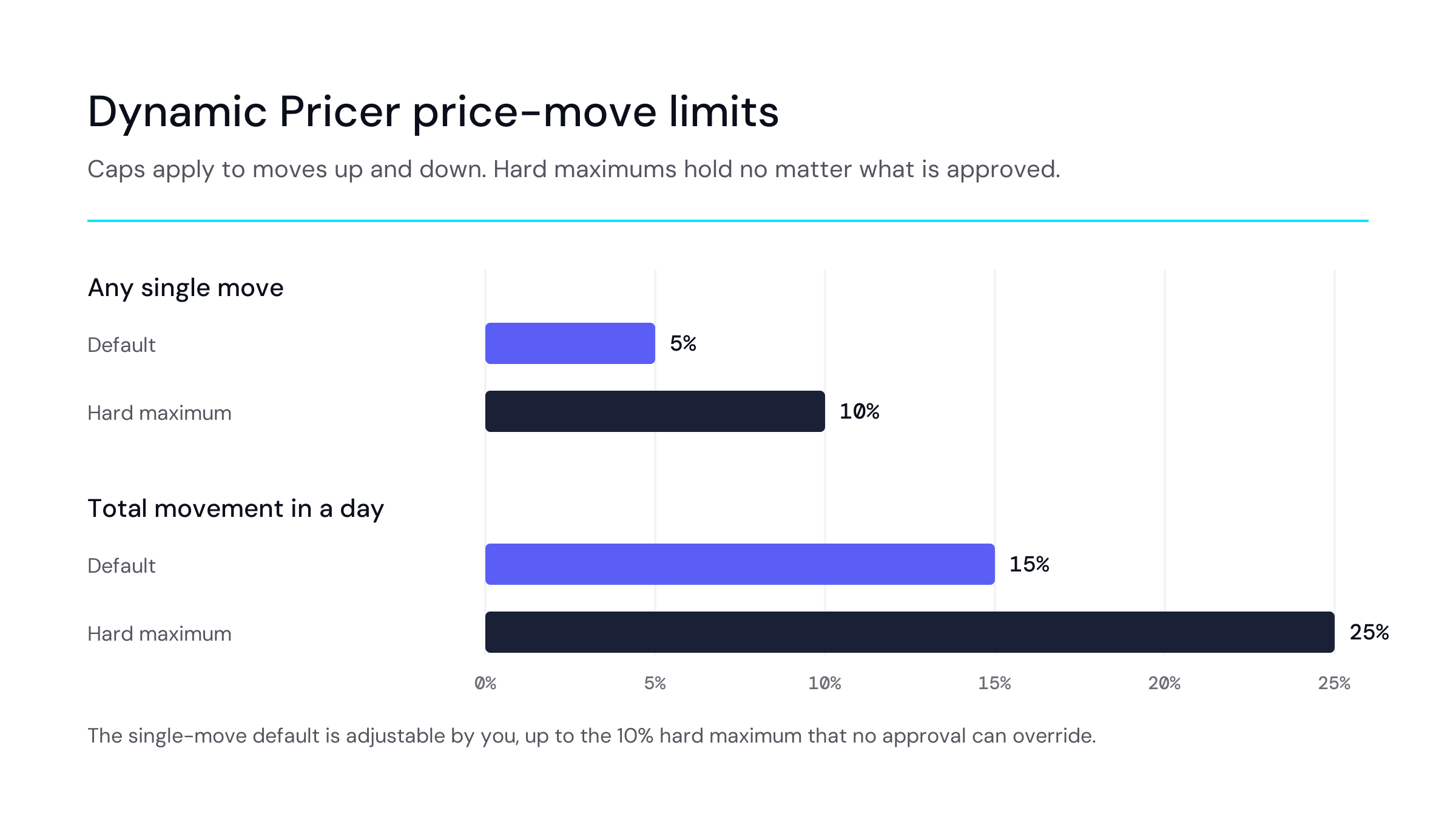
- Dynamic Pricer runs with seven hard safety rules that are always on: a margin floor, a MAP floor, a fair-pricing ceiling, genuine "was" prices only, a cap on any single move, a kill switch, and no reversal within 24 hours. Any single price move is capped in both directions: 5% by default, adjustable by you up to a hard maximum of 10% that no approval can override. Total movement in a day is capped too: 15% by default, and never more than 25%. A penny-price glitch cannot get through a wall like that.
- PPC Optimizer caps bids at 25% up and 50% down per change, and is designed to move a target's base bid about weekly, not hourly. It will not recommend raising spend into a stockout risk.
- Inventory Oracle pauses large reorders (over $5,000, or over 20% of 30-day revenue) for human review, and blocks reorders for listings that are inactive or cannot be bought.
- Product Scout runs inside spend limits you set, with a pause switch. A paused agent spends nothing.
- Account Guardian and Compliance Manager never write to your Amazon account at all.
Account changes in an approval card
When an agent wants to change something on your account, it does not just do it. The harness turns the change into an approval card for you.
A card shows what the agent wants to change, why, and what it is based on. You can approve, reject or edit.
By default, that covers every change to your Amazon account:
- Prices from Dynamic Pricer
- Bids, budgets, negative keywords and campaign changes from PPC Optimizer
- Listing content and images from Listing Builder
- Review requests from Review Intelligence
Some rules make approval stricter still:
- Titles in Listing Builder need a fresh approval every time and can never be automated.
- PPC proposals expire after 72 hours, so you are never approving a change based on stale data.
- Coupons, deals, list and strikethrough prices and the floor policy always need a human in Dynamic Pricer.
- Image generation in Listing Builder only happens after you confirm the cost.
A check on every action before it reaches your account
Approval is not the last step. Before any action reaches your account, the harness checks it again against the rules.
That final check catches problems that appear between the moment a change was proposed and the moment it goes out. If a change would cross a hard rule, like your margin floor or the 10% maximum price move, it does not go out.
Approval-gated, supervised, autonomous
The harness is built around three levels of control:
- Approval-gated: the agent prepares the change, you approve it.
- Supervised: the agent acts, you watch and can step in.
- Autonomous: the agent acts on its own inside limits you set.
Autonomy should be proportional to risk, and it is earned action by action. By default, every change goes through an approval card. Sellers can opt in to letting some agents act on their own, within limits they set.
Dynamic Pricer shows how earning works. Every action starts approve-first. After a clean record (around 20 clean approvals, or 30 days without a breach), the system may suggest more autonomy for that action. It only suggests. You are the one who grants it. And the agent never trips its own kill switch.
Every decision leaves a record
A harness is only useful if you can see what happened inside it. Agents keep a decision record: what was recommended, why, what you approved and what was sent. When something looks odd, you can trace it instead of guessing.
What changes for you
- Every change arrives as a card. Prices, bids, listing edits and review requests show what will change, why, and what it's based on. Approve, reject or edit.
- Big reorders wait for you. Anything over $5,000, or over 20% of 30-day revenue, is paused for your review.
- You're never approving stale data. PPC proposals expire after 72 hours, and titles need a fresh approval every time.
- You can always trace what happened. The decision record shows what was recommended, why, what you approved and what was sent.
Where you stay in control
The harness does not take you out of the loop. It removes the need for you to sit inside every loop, while the decisions that matter stay with you. It never lets an agent override your settings: your margin floor is your margin floor. And it does not quote odds it cannot measure. No agent shows suspension or appeal odds, and any estimate, like the profit an ad change might add, is labelled as an estimate.
The short version
Speed was never the hard part of automation. Trust is. The runtime harness limits what each agent can do, asks before it acts, and checks again before anything reaches your account.
FAQs
What is the runtime harness?
The software around Sydon AI's seller-facing agents while they run. It limits what each agent can do, by default puts every account change in an approval card, and checks every action again before it reaches your account.
Could a pricing glitch drop my prices to a penny?
Dynamic Pricer runs with hard rules that are always on, including your margin floor and a cap on any single price move: 5% by default, adjustable up to a hard maximum of 10% that no approval can override. Total movement in a day is capped too.
Do I have to approve every change?
By default, yes: prices, bids, budgets, listing content and review requests all come to you as approval cards that you can approve, reject or edit. You can opt in to letting some agents act on their own, within limits you set.
Will agents ever act on their own?
Only if you choose. Autonomy is earned action by action, and you are the one who grants it. In Dynamic Pricer, after a clean record (around 20 clean approvals, or 30 days without a breach), the system may suggest more autonomy for an action. It only suggests.
Can I see what an agent did and why?
Yes. Agents keep a decision record: what was recommended, why, what you approved and what was sent.
Build the brand, not the burden behind it.
Amazon, FBA, and Seller Central are trademarks of Amazon.com, Inc. or its affiliates, used here for descriptive purposes only. Sydon AI is not affiliated with or endorsed by Amazon.