Getting cited in ChatGPT search doesn't fix what happens after the click
AI-search visibility changes who finds a listing, not whether the account behind it can convert that shopper. This post walks through the operational failure points — suppression, stockout, Buy Box pricing, and review signal — that decide whether a newly discovered click turns into a sale.
A seller's product turns up inside a ChatGPT answer to a category question. Someone screenshots it and sends it to him. He opens Seller Central expecting a bump, even a small one. Nothing in his numbers moved. Not sessions, not units, not the ranking on the one keyword he actually tracks.
That's not a bug in the citation. It's the shape of the whole problem. Getting named inside an AI answer changes who finds the listing. It says nothing about what happens to that shopper once they arrive at the account behind it, and the account behind it is where the deal actually gets won or lost.
There's a wave of tools right now selling exactly this kind of visibility, and the demand for it is real enough that at least one is already running ads against it. What none of them are pricing is the layer directly behind the click: whether the listing that gets found is even eligible to sell, in stock, priced to win, or carrying enough review signal to survive a comparison.
The new front door
Perpetua reports that more product searches now begin directly on Amazon than on Google, which already makes Amazon the busiest product search engine most sellers will ever sell into. ChatGPT and Google's AI answers sit in front of that behavior rather than replacing it. A shopper types a category question into a chat window, gets a short list of products back, and one of them is your ASIN. That's a new way in.
It is not a new place shoppers go to buy. The eventual path for most of that traffic is still the same page, the same Buy Box, the same account. Being named earlier in that path is worth something. It is not worth the same thing as fixing what happens once the shopper actually lands on the page.
What gets a listing cited isn't what gets it paid
Helium 10 provides search volume, trend data, and long-tail keyword expansion for any keyword, and that's a genuinely useful thing to know before you spend money chasing a term. Helium 10 is also currently targeting sellers specifically worried about being discovered in ChatGPT and Google AI search, which tells you the appetite for this kind of visibility is real enough to buy ads against.
None of that describes what happens after the shopper clicks through. Search volume measures interest. It has no view into whether the listing that interest lands on is in stock, priced to hold the Buy Box, carrying enough review signal to survive a side-by-side comparison, or even still live for sale. A keyword tool can tell you demand for a term went up. It cannot see your account at all.
The lag between seeing a shift and acting on it
Jungle Scout reports that search volume shifts often precede revenue shifts by 30 to 90 days. That's the visibility case for AI-search tools in one sentence: catch the shift early, act before revenue confirms it. It's a real argument, and it's the reason this category of tool exists at all.
It's also a window, not a fix. Thirty to ninety days is exactly long enough for a listing to go from ranked and cited to suppressed, out of stock, or priced out of the Buy Box, and for none of that to have anything to do with the search shift that got noticed. Seeing the demand curve bend early buys time. It doesn't spend that time on your behalf.
What's waiting on the other side of the click
A shopper who found the listing through an AI answer still has to survive contact with the account the same way every other shopper does. Four things decide whether that click turns into a sale, and none of them show up in a keyword tool.
Suppression and eligibility. Account Guardian watches 47+ risk factors, including the compliance and eligibility flags that can pull a listing from sale before the newly found shopper ever sees it. Stockout. Inventory Oracle predicts stockouts and recommends restocks, because a listing that surges in discovery and runs dry a week later converts nothing for the rest of that window. Buy Box pricing. Dynamic Pricer enforces a margin floor while competing for the Buy Box, and a click that lands on a listing that's lost it is a click handed to a competitor. Review signal. Review Intelligence feeds rating and review-velocity signal into pricing and forecasting, because a listing with thin, stale reviews loses a real share of comparison shoppers regardless of how it got found.
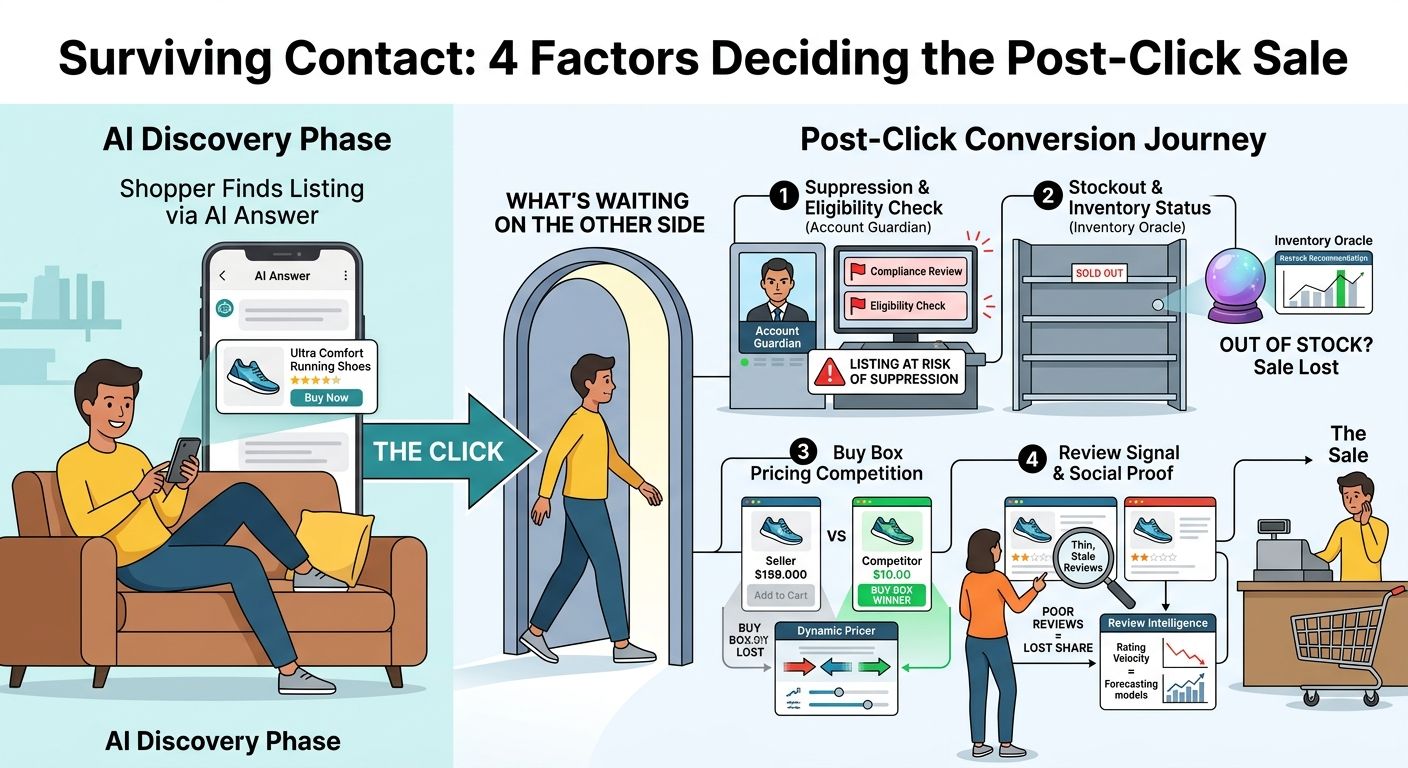
Getting cited is the easier half of this problem. It's also the only half currently being sold as a fix.
What this doesn't do
sydon doesn't have an agent that gets a listing surfaced or cited inside ChatGPT or Google's AI answers, and no live agent influences that layer today. That discovery mechanism sits outside the twelve agents currently in production. If the plan is to specifically buy visibility inside AI search results, that's a different tool, and this isn't a pitch to replace it.
What the twelve agents do cover is the layer directly behind that click: keep the listing eligible, keep it in stock, keep the price where it wins the Buy Box without giving away margin, keep the review signal healthy. That's a narrower claim than getting discovered, and it's the one that decides whether the discovery ever pays for itself.
Questions worth asking before adding another tool
Should I still try to get discovered in ChatGPT and Google AI search?
There's no reason not to. It's upstream of buying behavior that's already Amazon-first, and being named early in that path costs a shopper's attention, not their whole decision. Just don't budget it as the whole fix. It changes who finds the listing. It doesn't touch what they find once they get there.
Is this the same problem as PPC waste?
Related but not identical. PPC waste is spend chasing search terms that never convert. An AI-search citation is a click you didn't pay for that still has to survive the same account-side failure points as a paid one. Either way, the fix is on the listing and the account, not on the discovery channel that sent the shopper there.
How do I know if my account is the weak link rather than my visibility?
Pull the SKUs that get impressions or citations and check four things: current suppression or policy flags, days of inventory cover, current Buy Box status, and review velocity over the last few months. If any of those is off, more discovery just funnels more shoppers into the same leak.
Does sydon plan to add AI-search discovery as an agent?
Not something to promise here. The twelve live agents cover the operational layer behind the listing: compliance, inventory, pricing, reviews, fulfillment, documents, and the rest. Discovery inside chat-based search isn't part of that set today, and this post isn't the place to claim otherwise.