The Complete Guide to Amazon Account Health Software (2026)
Amazon's Account Health Dashboard shows you 5 metrics. Amazon monitors 47. This guide explains what account health software actually does, what to look for, and why the gap between 5 and 47 signals is where most suspensions originate.
Your Account Health Dashboard is not telling you the full picture
Amazon's Account Health Dashboard shows sellers five performance metrics: Order Defect Rate, Late Shipment Rate, Pre-Fulfillment Cancellation Rate, Valid Tracking Rate, and Customer Service Dissatisfaction Rate.
Amazon's systems monitor 47 compliance signals before making a suspension decision.
That gap, between the 5 you can see and the 47 Amazon watches, is where most suspensions originate. Sellers with perfect core metrics get suspended because of signals that never appeared in their dashboard.
What Amazon account health software actually does
Account health software monitors your Amazon seller account for compliance risks, policy violations, listing issues, and account health changes, alerting you before Amazon takes action.
The distinction that matters: there is a difference between a tool that monitors and alerts versus a tool that monitors and acts. Most tools alert. A few act.
Monitoring and alerting
The baseline capability. The software scans your account on a schedule (hourly, daily, or continuously) and sends you a notification when something changes. You receive the alert. You take the action.
- Account Health Dashboard monitoring — tracks the 5 visible metrics
- Listing health monitoring — flags ASIN suppression, stranded inventory, listing violations
- Policy warning detection — surfaces Amazon policy notification emails before they escalate
- Competitor activity alerts — notifies when competitors make changes that affect your ranking
Monitoring and acting
The more advanced capability. The software identifies an issue and takes a predefined action without waiting for you to log in. This is the difference between finding out your listing was suppressed at 2am versus having the issue resolved before you wake up.
- Automatic relisting of suppressed ASINs where the fix is deterministic
- Proactive policy compliance — adjusting listings before a violation is flagged
- SP-API compliance monitoring — verifying that third-party tools connected to your account are registered under Amazon's March 2026 Agent Policy
The 47 signals: what Amazon monitors beyond your dashboard
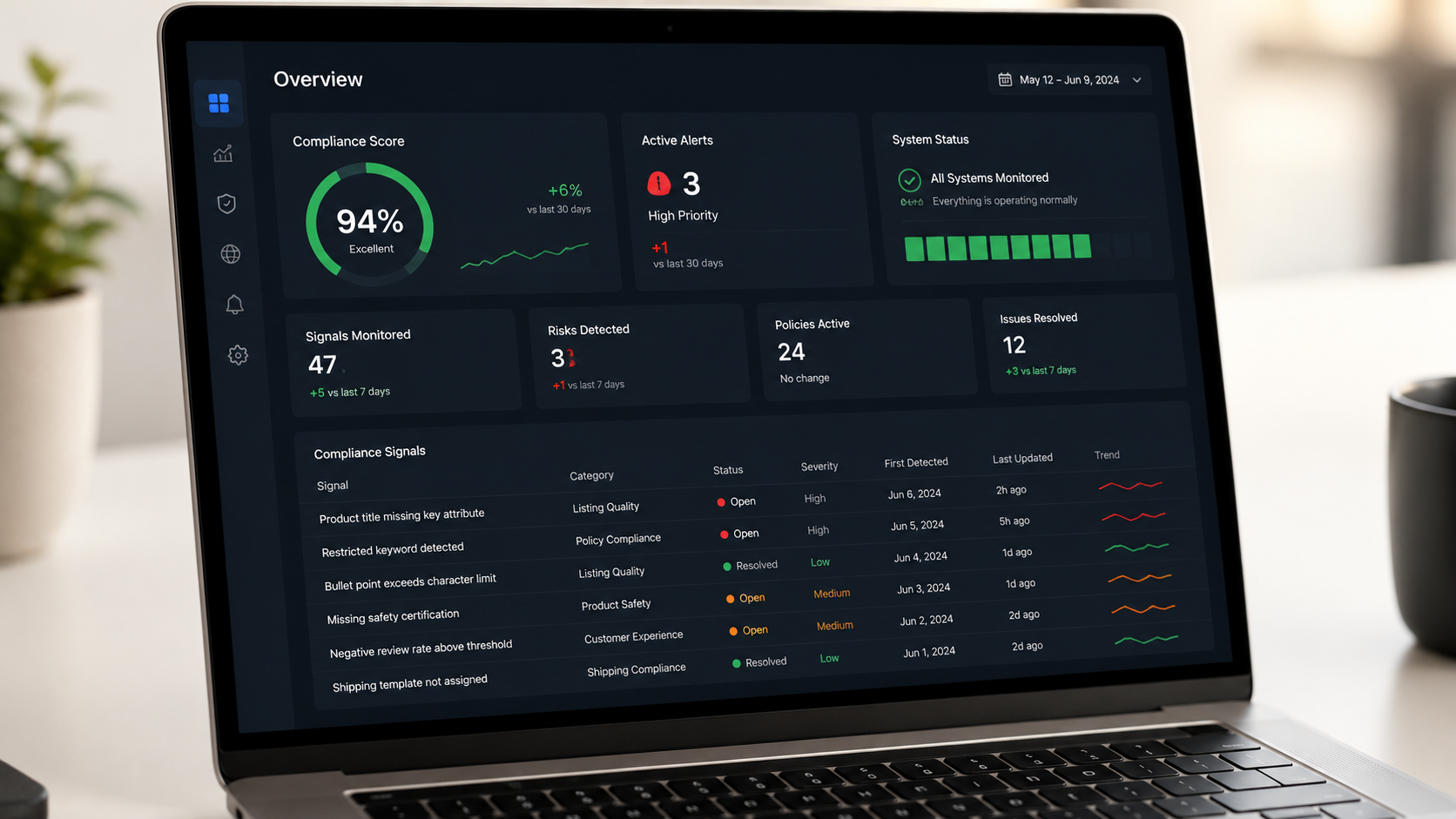
Amazon groups account health signals into five broad categories. Understanding what falls outside your visible dashboard is the first step to protecting against it.
General compliance (17 signals beyond the core 5)
- Backend keyword violations — keywords in your search terms field that violate Amazon policy (competitor brand names, prohibited claims)
- Fair pricing compliance — pricing that Amazon's algorithm flags as significantly above market rate
- Buyer-seller messaging violations — communication outside Amazon's approved message types
- Product authenticity documentation — brand authorization and invoice requirements for gated categories
- Listing image requirement compliance — images that technically pass review but accumulate policy drift
- Review solicitation compliance — any variation from Amazon's approved review request language
Supplements and health (10 signals)
The most suspension-prone category on Amazon. Sellers in supplements, vitamins, and health products face a separate layer of compliance requirements:
- FDA claim language — any implied disease claim in product title, bullets, or description
- TIC (Testing, Inspection, and Certification) verification — required documentation for certain supplement categories
- Label compliance — supplement facts panel format requirements
- Ingredient disclosure requirements — specific to Amazon's dietary supplement category policies
Electronics and IP (8 signals)
- IP complaint exposure — cumulative intellectual property complaints that build toward suspension threshold
- Brand authorization documentation — increasingly required for electronics and branded goods
- Safety certification requirements — CE, FCC, UL documentation for applicable products
Beauty, baby, and pet (8 signals)
- Safety data sheet requirements for applicable products
- Age restriction compliance
- Ingredient restriction compliance — EU and US regulatory requirements for cross-border sellers
Quarterly audit items (4 signals)
Amazon conducts periodic account reviews that look beyond daily metrics at seller history, dispute patterns, and account age relative to category and volume. These signals are not visible in Seller Central at all — they are assessed internally by Amazon's seller compliance team.
What to look for in Amazon account health software
Not all account health tools are the same. Here is what separates a genuine compliance monitoring tool from a basic notification service.
Continuous monitoring vs scheduled scans
Basic tools run scans on a schedule, daily or weekly. Continuous monitoring watches your account in real time. For suspension prevention, the difference matters: a policy violation that builds for a week before you are notified is a week closer to Amazon taking action.
SP-API registration: the new requirement most tools ignore
In March 2026, Amazon introduced the SP-API Agent Policy, requiring all third-party tools operating on the Amazon platform to register under a new compliance framework. Tools that are not registered operate in a grey area that Amazon is beginning to enforce.
When evaluating account health software, check whether the tool is SP-API registered under Amazon's March 2026 Agent Policy. Most tools have not confirmed registration. A non-registered tool connected to your account is itself a compliance risk.
The difference between alerting and acting
An alert tells you there is a problem. An agent fixes the problem. For sellers managing large catalogs across multiple channels, the distinction between being notified at 3am and having the issue resolved before you woke up is material to how your business runs.
Amazon account health software options in 2026
Helium 10 — Account Health monitoring
Helium 10's account health features are part of its broader suite. It monitors key metrics and alerts on changes. It does not continuously monitor all 47 compliance signals. Price: $359/month for Diamond (monthly billing).
Jungle Scout (Catalyst) — Account health features
Jungle Scout (Catalyst)'s account health tools focus on the core visible metrics. It does not offer deep compliance monitoring beyond the Amazon dashboard signals. Price: $149/month (top tier; plans start from $49/month — verify current Catalyst pricing).
SellerBoard
Primarily a profit analytics tool that includes some account health monitoring. Strong on financial visibility, not the strongest on compliance monitoring. Starts at $15/month for limited features.
Sydon — Account Guardian (free forever tier available)
Account Guardian monitors your Amazon account 24/7 across all 47 compliance signals and alerts before Amazon acts. It tracks SP-API registration status under Amazon's March 2026 rules, watches for listing flags and policy warnings, and operates continuously rather than on a scan schedule.
Account Guardian is available as a permanent free tier, no credit card, no trial countdown, no expiry. The paid tier ($149/month) adds agents that act on the alerts: adjusting listings, filing reimbursements, optimizing PPC, and defending against review attacks automatically.
The most important account health action to take today
Check whether the third-party tools connected to your Amazon account — repricers, PPC tools, listing software, inventory management — are registered under Amazon's March 2026 SP-API Agent Policy.
Most are not. A non-registered tool connected to your seller account creates compliance exposure that will not appear in your Account Health Dashboard until Amazon acts on it.
Account Guardian monitors this as one of its continuous checks. Claim the free tier below and see your compliance status within 2 minutes of connecting your account.